

Virtual Desktop Automation Architecture & Control Plane Design
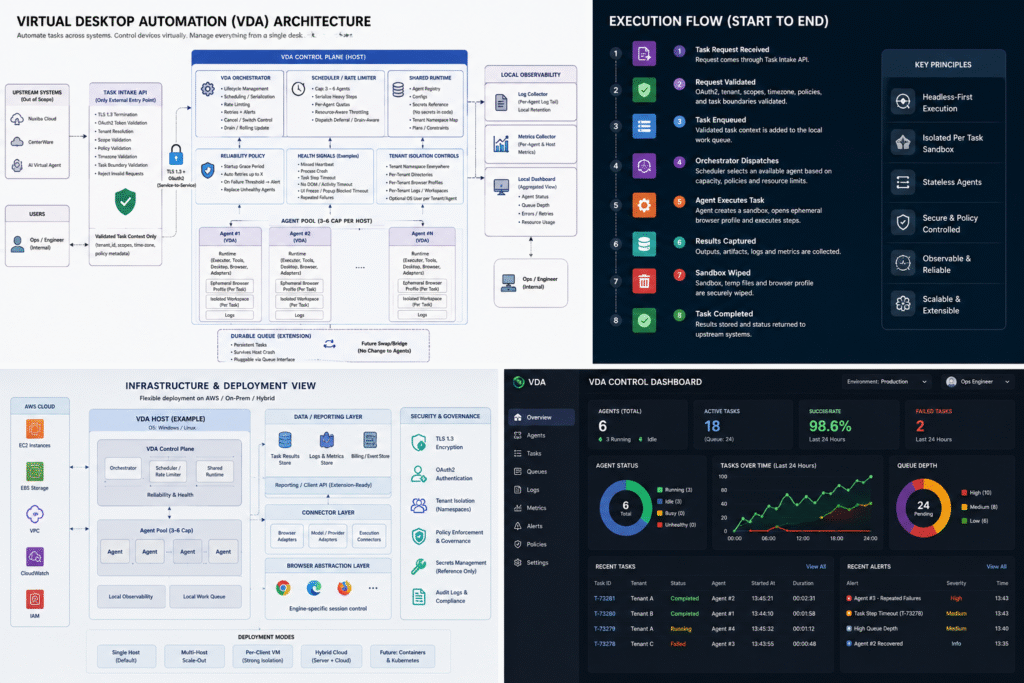
Designed a complete architecture specification for a virtual desktop automation platform that manages task execution across controlled agent processes, isolated browser sessions, task queues, sandboxes, observability, governance controls, and deployment-ready infrastructure.
Description
This project focused on designing the architecture and technical specification for a Virtual Desktop Automation platform, also referred to as a Virtual Desk / Virtual Desktop Agent system. The platform was designed to automate tasks across different systems by allowing controlled virtual execution, device/session control, browser-based automation, task orchestration, and centralised work management from a single operating environment.
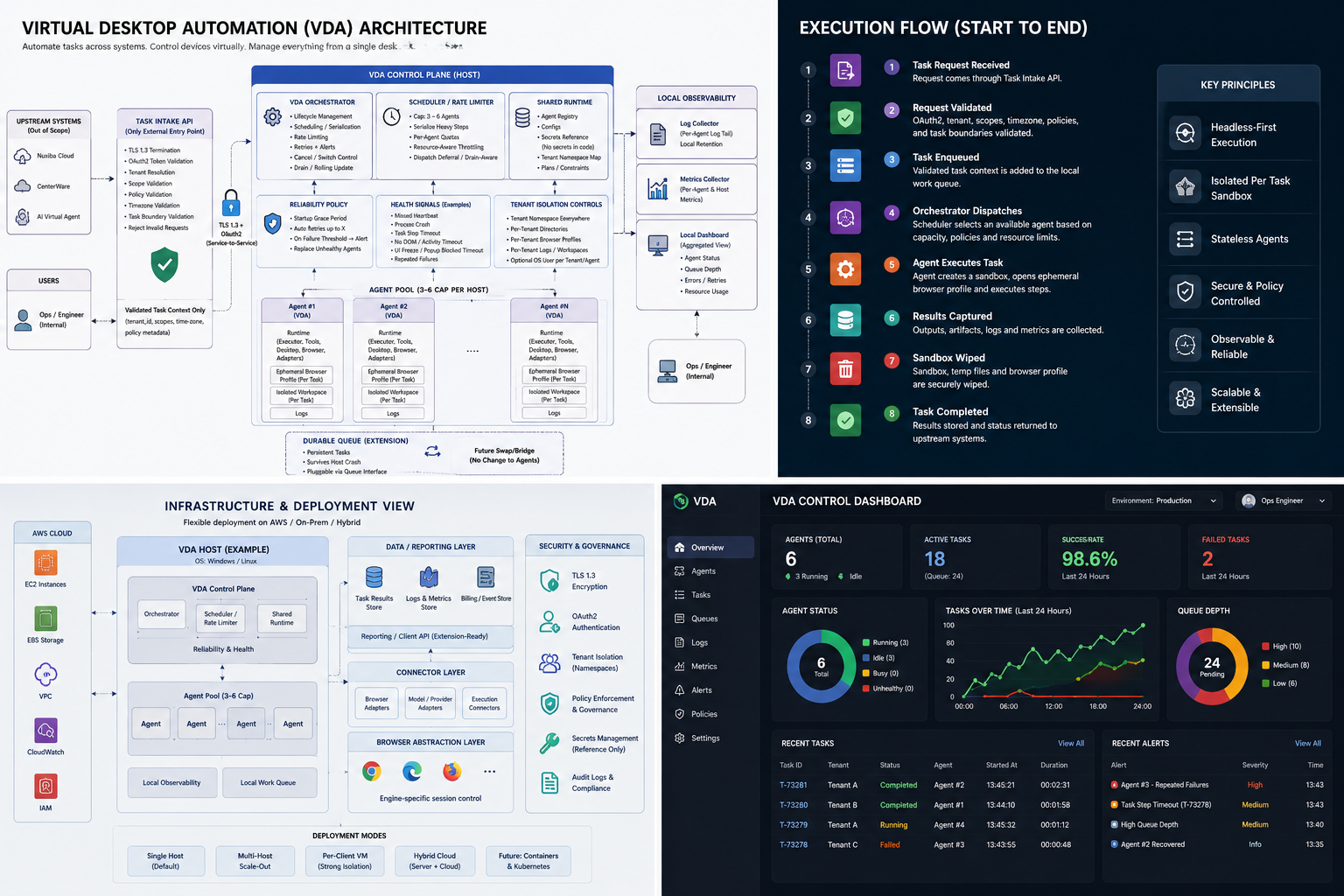
The architecture introduced a host-based VDA control plane that could run on Windows or Linux and manage multiple agent processes within defined CPU, RAM, storage, and concurrency limits. The design followed a process-per-agent model, where each agent could execute tasks independently without affecting other agents. The system was designed with a realistic concurrency cap of 3–6 agents per host, headless-first execution, and optional isolated RDP sessions when visible desktop control was required.
A key part of the architecture was the VDA Orchestrator, which acted as the single authority for lifecycle management, task scheduling, dispatch control, retries, cancellation, switching, rolling updates, health checks, and policy enforcement. Tasks entered the system only through a secure Task Intake API using TLS 1.3 and OAuth2 validation. After request validation, tenant resolution, scope validation, policy checks, and task-boundary validation, only approved task contexts were forwarded to the control plane.
The project also defined a local work queue, scheduler/rate limiter, shared runtime, reliability policy, sandbox manager, browser abstraction layer, connector layer, and data/reporting layer. Each task was designed to run inside a fresh per-task sandbox with an ephemeral browser profile and isolated workspace. After execution, the sandbox had to be securely wiped before the task could be acknowledged as complete. This helped prevent session leakage, cookie persistence, cross-task contamination, and cross-tenant data exposure.
The architecture included detailed governance and restriction rules, including no-go task handling, CAPTCHA/manual-intervention policy, prompt/task boundaries, timezone policy, cancellation/switching policy, and connector/model security rules. It also covered observability through per-agent logs, metrics collectors, local dashboards, alerting, health signals, failure recovery, and future centralized observability or SIEM integration.
The deployment strategy supported default host deployment, server-first deployment, VM/container readiness, optional multi-host scale-out, durable queue extension, and zero-downtime safe rollout through drain-and-replace behaviour. The final architecture provided a clear blueprint for building a scalable, secure, observable, and policy-controlled virtual automation platform suitable for browser-based task execution and operational workflow automation.
Key Contributions & Strategic Impact
Hussnain Ali Hamza contributed by preparing a complete architecture specification and infrastructure design for a virtual desktop automation platform. The work converted a complex automation concept into a structured technical blueprint covering task intake, orchestration, scheduling, agent lifecycle, sandbox isolation, browser automation, connector extensibility, observability, governance, security, deployment strategy, and testing/validation. The strategic value of the project was in creating a production-aware foundation that could guide implementation, AWS/server deployment planning, operational monitoring, and future scaling.
Key Points
- Designed the target architecture for a Virtual Desktop Automation / Virtual Desk Agent platform.
- Defined a host-based VDA control plane for Windows/Linux environments.
- Designed Task Intake API as the only secure external entry point using TLS 1.3 and OAuth2 validation.
- Created Orchestrator-led lifecycle control for scheduling, dispatch, retries, cancellation, switching, health checks, and rolling updates.
- Defined a process-per-agent execution model with a realistic 3–6 agent cap per host.
- Designed headless-first execution with optional isolated RDP sessions for visible desktop workflows.
- Introduced per-task sandboxing with ephemeral browser profiles, isolated workspaces, and mandatory wipe confirmation before completion.
- Defined scheduler/rate limiter rules for resource-aware dispatch, heavy-step serialization, per-agent quotas, and queue backpressure.
- Covered tenant isolation through tenant IDs, namespace mapping, per-tenant directories, scoped logs, scoped profiles, and optional VM-level isolation.
- Designed observability through per-agent logs, metrics collector, local dashboard, health signals, alerts, and centralized observability extension path.
- Defined governance controls for no-go tasks, CAPTCHA handling, prompt/task boundaries, timezone policy, cancellation, switching, and manual intervention.
- Covered connector/model extensibility through browser abstraction, connector contracts, approved provider routing, normalized responses, and secure runtime configuration.
- Included testing and validation planning for functional, integration, performance, stress, reliability, governance, security, and cross-platform validation.
- Prepared deployment strategy covering host deployment, server-first deployment, VM/container readiness, multi-host scale-out, safe rollout, environment requirements, and deployment risks.
Strategic Value Summary
This project delivered a complete technical and infrastructure architecture for a virtual desktop automation platform. By combining orchestration, secure task intake, controlled agent execution, sandbox isolation, governance, observability, and deployment planning, the project created a strong foundation for building a scalable and secure automation system capable of managing virtual tasks across multiple controlled environments.