

MuoTech Solution Architecture
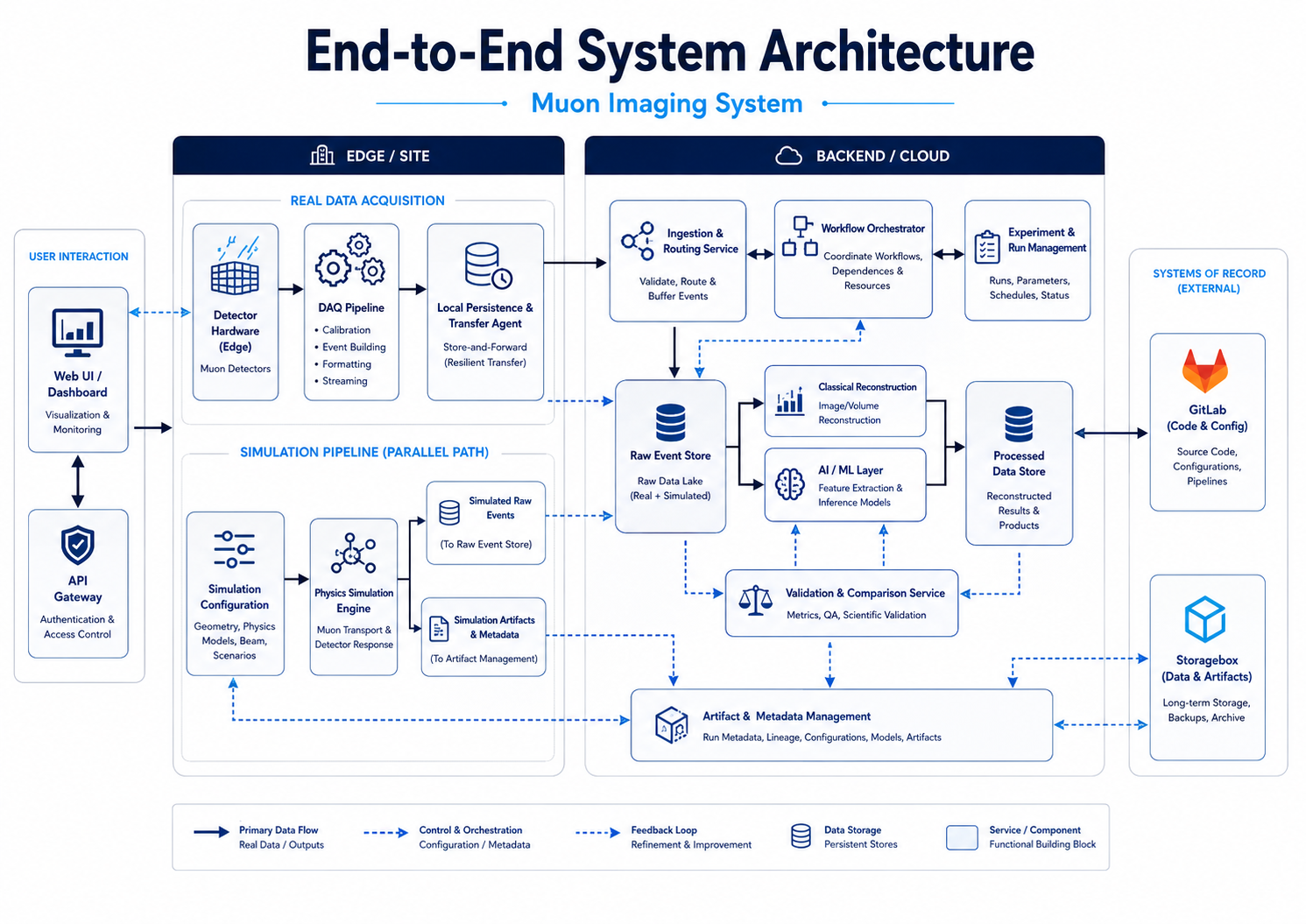
This project focused on defining the end-to-end architecture and pipeline architecture for a specialized muon imaging system. The goal was to transform a complex scientific and engineering workflow into a clear, structured, and implementation-ready architecture that could support simulation, real detector data acquisition, data processing, reconstruction, AI/ML enhancement, validation, and user-facing visualization.
The architecture covered the complete system lifecycle, from muon detection and simulation through to processed outputs, quality checks, metadata management, and final result delivery. A major part of the work involved defining the system boundary, clarifying in-scope and out-of-scope components, and mapping how detector hardware, DAQ pipelines, backend services, storage layers, reconstruction modules, AI/ML components, validation services, and UI layers should interact.
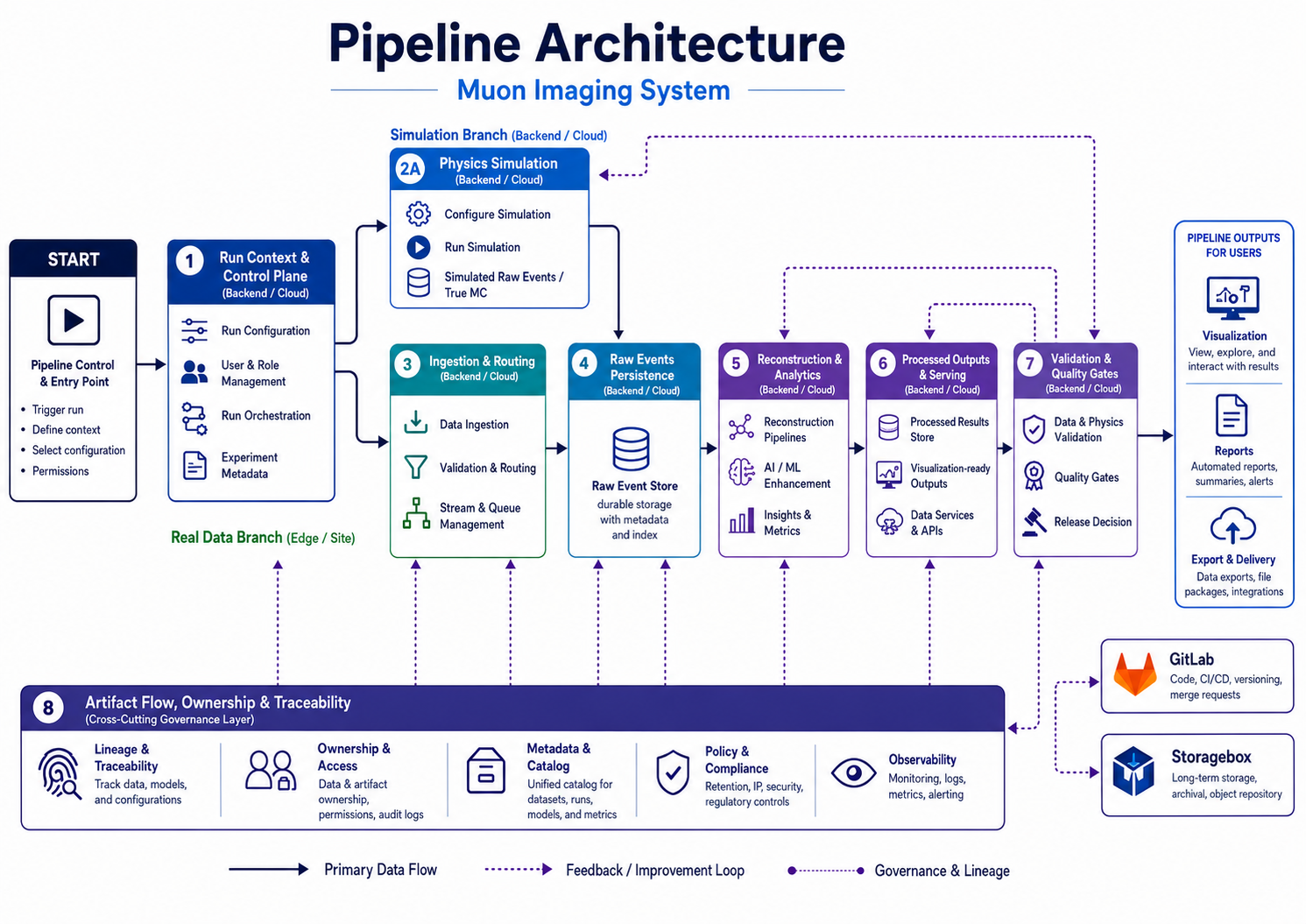
A key architectural decision was to separate the simulation pipeline and real-data pipeline during acquisition and early processing, while allowing them to converge at shared reconstruction, analytics, and validation stages. This approach improved data provenance, supported comparison between simulated and real scan results, and created a stronger foundation for future algorithmic refinement.
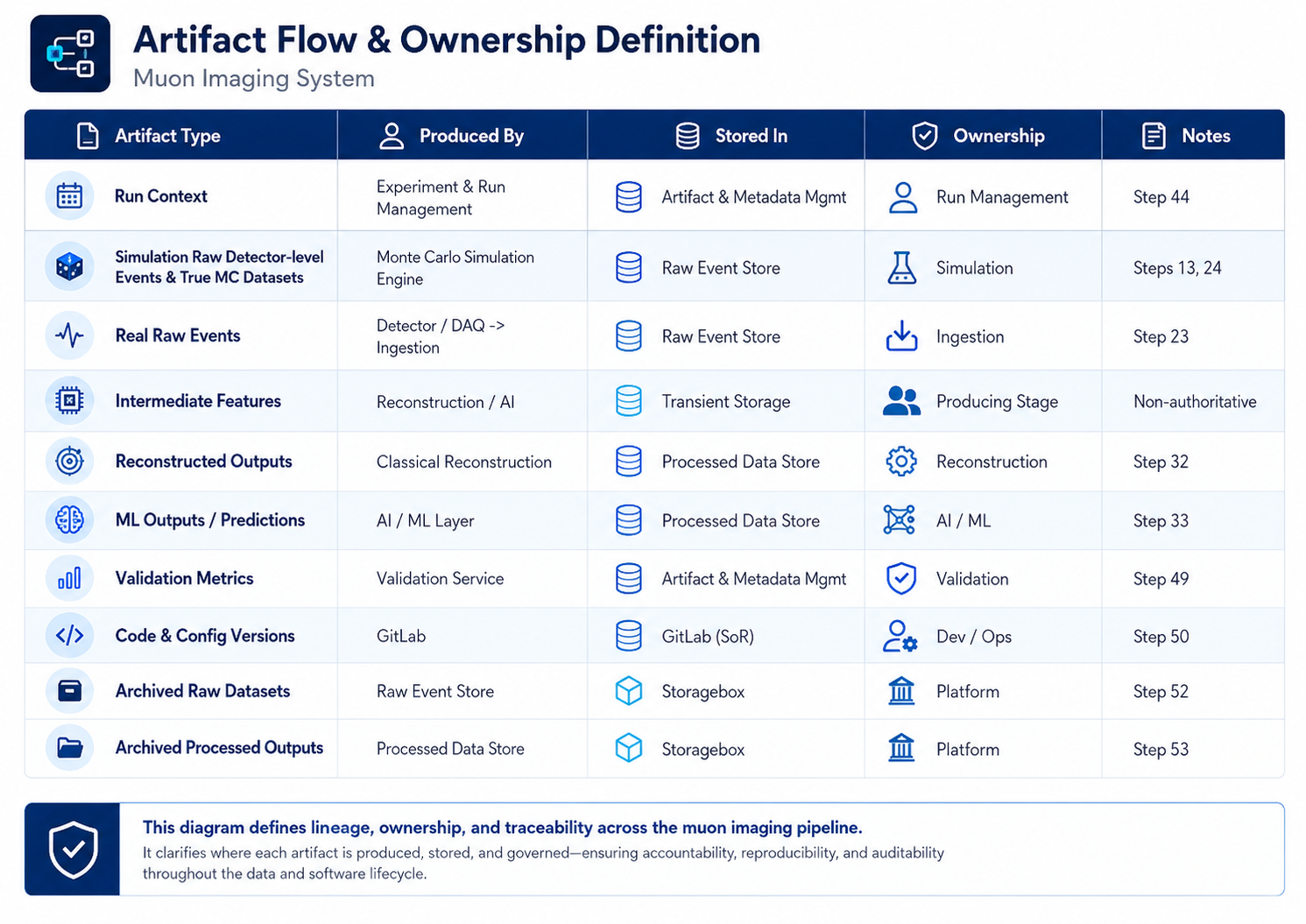
The pipeline architecture was designed with clear stages, entry and exit criteria, artifact ownership, traceability, and feedback loops. This ensured that each stage of the system had defined responsibilities, expected inputs, expected outputs, and governance logic. The resulting architecture provided the client with a practical foundation for MVP implementation, future scalability, and production-readiness.
Key Contributions & Strategic Impact
My role extended beyond producing architecture diagrams. I helped convert a highly technical muon imaging concept into a structured delivery framework that could guide physics, software, data, AI/ML, and UI teams. The work reduced ambiguity across the system, clarified ownership of each pipeline stage, and created an architecture that supports scalability, reproducibility, validation, and long-term maintainability. This gave the client a clearer path from research-stage concepts toward an execution-ready imaging platform.
- Defined the end-to-end architecture covering detector hardware, DAQ, simulation, orchestration, reconstruction, AI/ML, validation, UI, storage, and metadata management.
- Designed a dual-pipeline model separating simulation data and real detector data before convergence at shared reconstruction, analytics, and validation stages.
- Created a delivery-ready pipeline structure with clear stages, entry criteria, exit criteria, responsibilities, and output artifacts.
- Established traceability through run metadata, configuration references, artifact ownership, GitLab-based code/configuration versioning, and Storagebox-based data/artifact storage.
- Supported scalability and field-readiness by introducing edge-to-cloud data flow, local persistence, backend ingestion, raw/processed data separation, and validation-driven feedback loops.

Strategic Value Summary
This project demonstrates the ability to design complex technical systems where scientific workflows, hardware interfaces, data pipelines, AI/ML components, and user-facing applications must work together as one coordinated platform. The value delivered was not only a set of diagrams, but a structured architectural foundation that improved technical clarity, reduced delivery risk, supported future MVP development, and prepared the muon imaging system for scalable implementation.